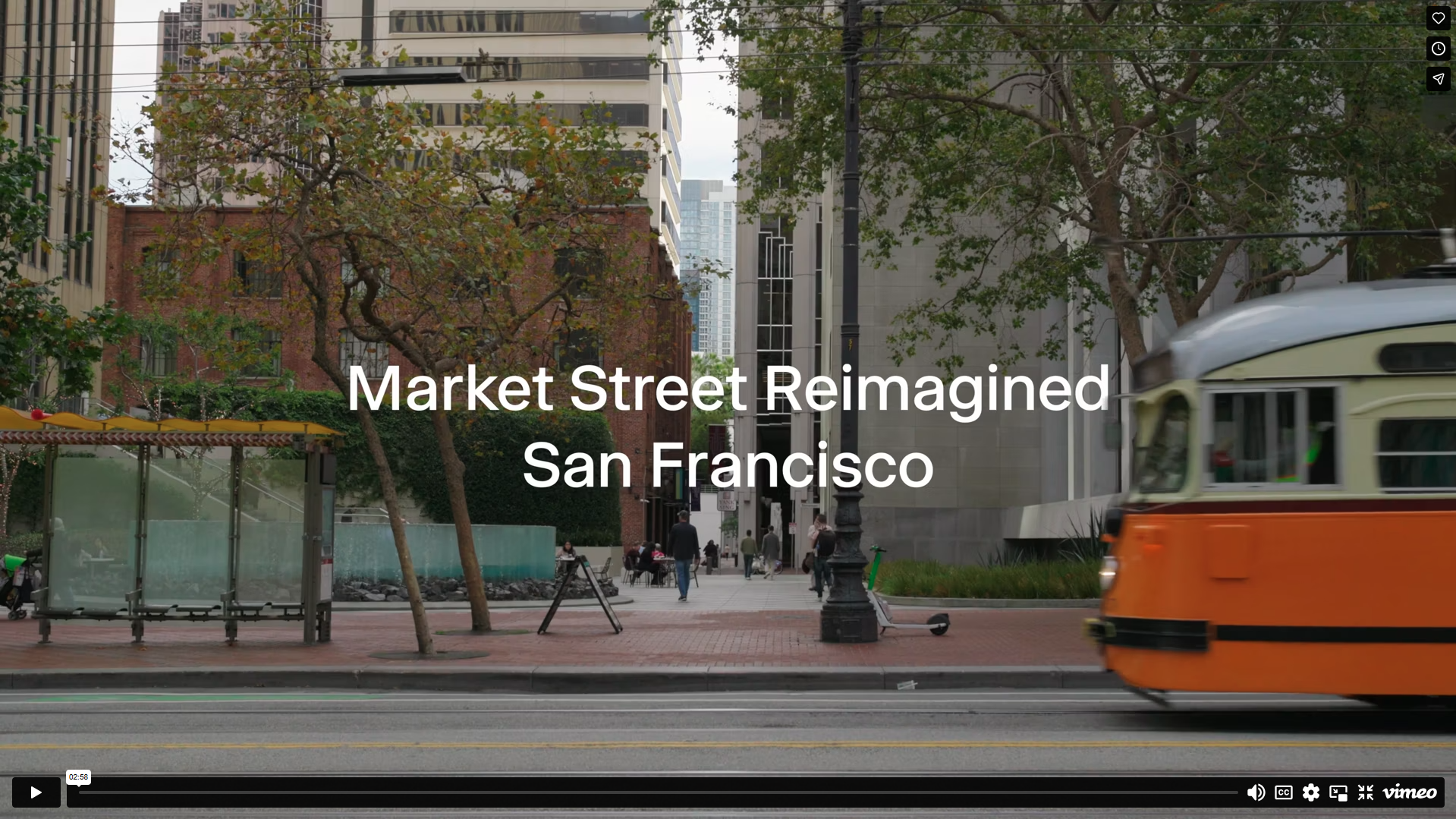
Video credit: Multistudio
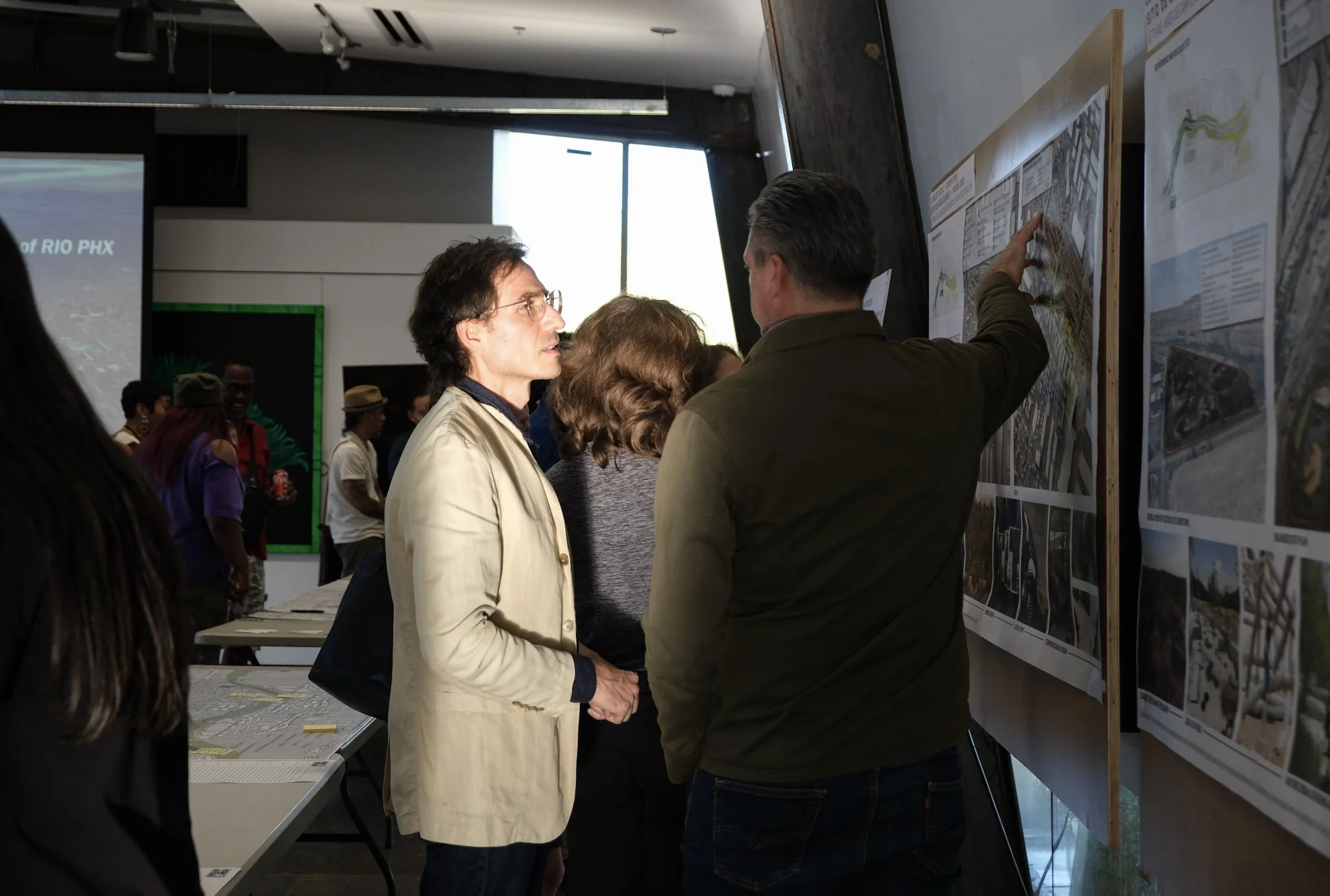
Rio Reimagined Community Workshop 2025. (Image credit: Multistudio)
The Urban Theater: The Irregular, the Unexpected, and the Social Connection
A Conversation with Luca Giaramidaro on the Role of Culture and the Public Realm in Shaping San Francisco’s Future
Luca Giaramidaro joined Multistudio in the late summer of 2024 as Vice President and Senior Planner in our San Francisco studio. Trained as an architect in Italy, he holds a doctorate degree in Sustainable Design from Sapienza University of Rome and has spent the past 17 years in the Bay Area working on Urban Regeneration, Transit-Oriented Development, and Transportation.
In July 2025, Luca Giaramidaro led a design collective for the Market Street Reimagined Competition, an international ideas competition organized by Urban Land Institute San Francisco (ULI SF), which was honored with the Award for Place-Making and Connected Neighborhoods. This award is further confirmation of Luca's swift impact at our studio and speaks to his vision for Multistudio’s role as a leader in Urban Development in the Bay Area and beyond.
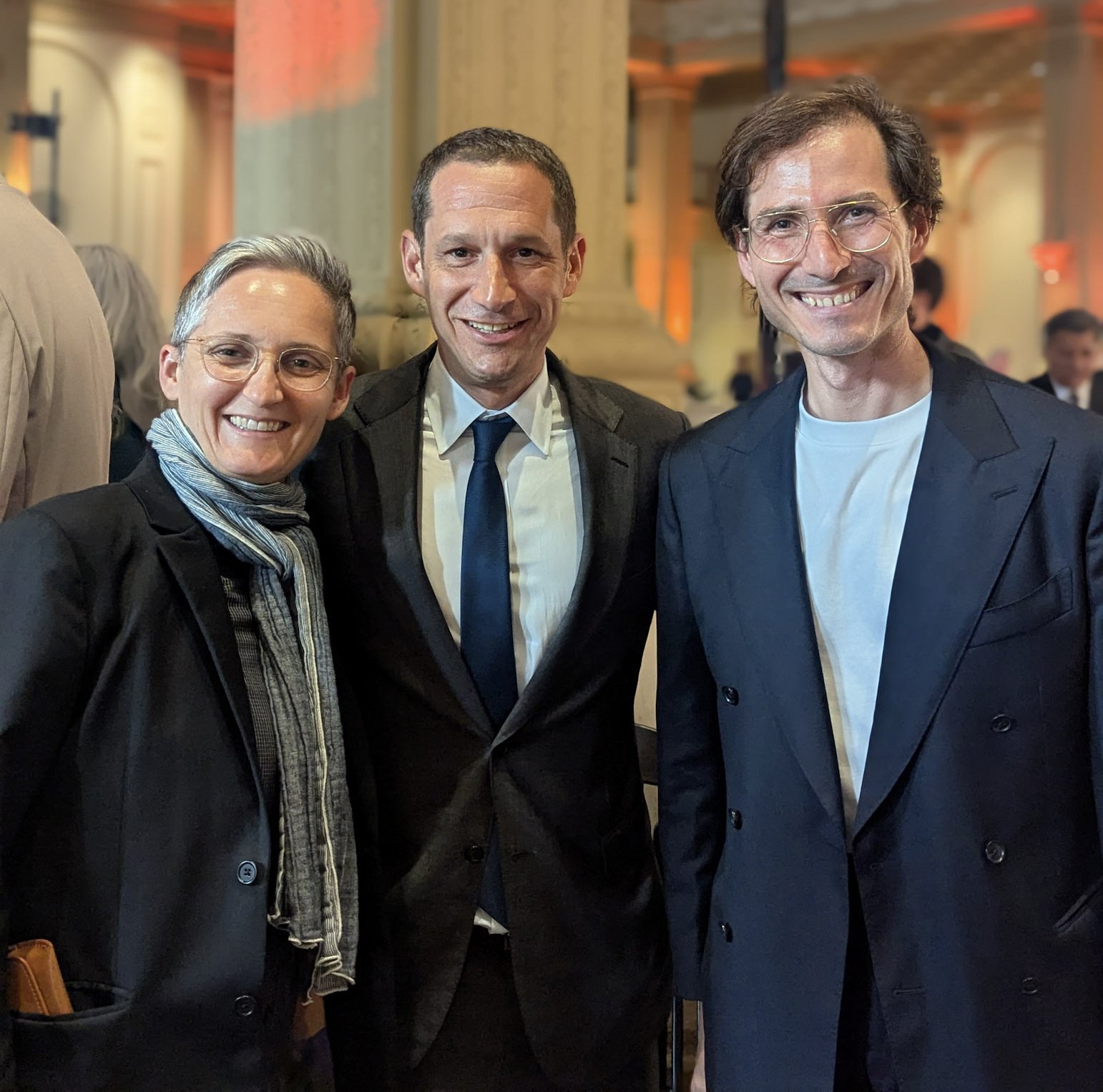
L to R: Monica Way of Studio-MLA, Daniel Lurie, Mayor of San Francisco, and Luca Giaramidaro
We sat down with Luca to learn more about his recent success, his approach to planning and urban design, and his design philosophy.
Multistudio (M): What drew you to Multistudio?
Luca Giaramidaro (LG): Coming from larger firms, I was drawn to Multistudio’s intimate scale and cross-disciplinary approach. After the pandemic, I took some time back in Italy to reset and reconnect with my roots. When I returned to San Francisco, I wanted to re-engage with my professional network on a more personal level. I already knew Bob Baum (Principal Emeritus) from a previous collaboration, and when we later reconnected, the conversation flowed naturally. Joining Multistudio felt like a great opportunity to break new ground.
M: What do you hope to accomplish?
LG: My role as Vice President at Multistudio is to help grow our Urban Development and City Design practice, positioning the firm as a trusted voice in shaping the Bay Area’s future while also expanding our services firmwide. That means building relationships that matter and advancing projects that shape cities in meaningful ways.
For me, those professional goals align with a personal belief: that culture and the public realm are powerful forces to bring people together, and they are key to rewriting San Francisco’s next chapter as well as the future of many other cities across the United States.
M: In your view, what makes San Francisco a unique place to test new ideas in planning and urban design?
LG: San Francisco has always been a city of transformation. Take the public realm as an example. When I moved here in 2008, I watched the parklet movement take off. What began as a guerrilla-style intervention evolved into an effective solution that responded to people’s desire for a different kind of public space.
In 2020, those interventions became essential strategies for San Francisco’s health and economic resilience. The pandemic shook the city’s soul, and as we now reset its course, it’s clear that we must start by nurturing our sense of community. The city is clear-eyed about the role the public realm must play in that effort. That resonates deeply with me because, in my upbringing, the social dimension of the public realm was always present.
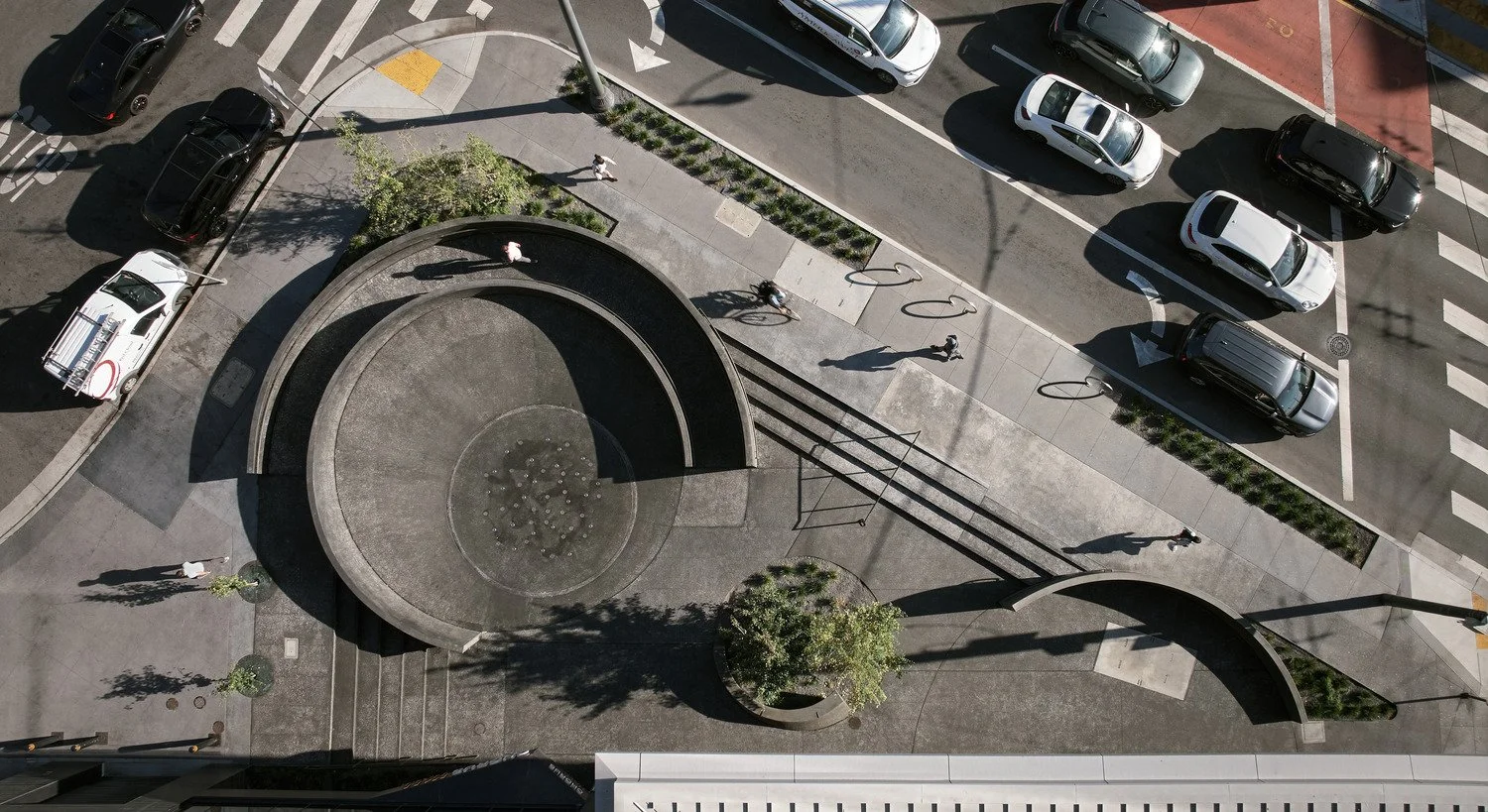
In collaboration with the development team, Frida Escobedo, and Studio Fletcher, we shaped a public realm that fosters civic engagement and quiet reflection within a busy corridor. (Image credit: Multistudio)
It’s also why I see today’s urban challenges not just as infrastructural, but fundamentally cultural. And nowhere is this more visible than downtown, where the lack of a residential community and a slow return to office have left the area without the daily rhythms that once sustained it. The task now is to give people renewed reasons to come back — to spend time there, to connect, and to experience the city again. From street closures to cultural programming, night markets, and festivals, a wave of new initiatives is being tested to draw people back into downtown. In this way, San Francisco remains what it has always been: a living experiment.
M: You recently received the Award for Place-Making and Connected Neighborhoods in the Market Street Reimagined competition from ULI SF. How did you respond to their call for entries to reimagine Market Street’s future in a post-pandemic downtown?
LG: We approached the competition as an opportunity to reframe Market Street not just as a transportation corridor, but as a civic platform for culture and connection. We’re all too familiar with the social media platforms right in our pockets, but plazas and streets are the original physical platforms. Urban spaces are where culture is expressed and community is strengthened — and that idea became the foundation of our submission.
The first step for us was addressing transportation, the backbone of Market Street. We doubled down on a transit-, bicycle-, and pedestrian-first environment, celebrating the historic character of the streetcar while creating a safe and pleasant experience for cyclists and pedestrians. Reducing vehicular lanes allowed for dedicated bike lanes, generous sidewalks, and landscaped pockets that introduce restorative urban ecology. These green pockets weave along the corridor, slowing riding speeds and adding delight to the daily commute, while wider sidewalks provide room for everyday life to spill out and animate the street.
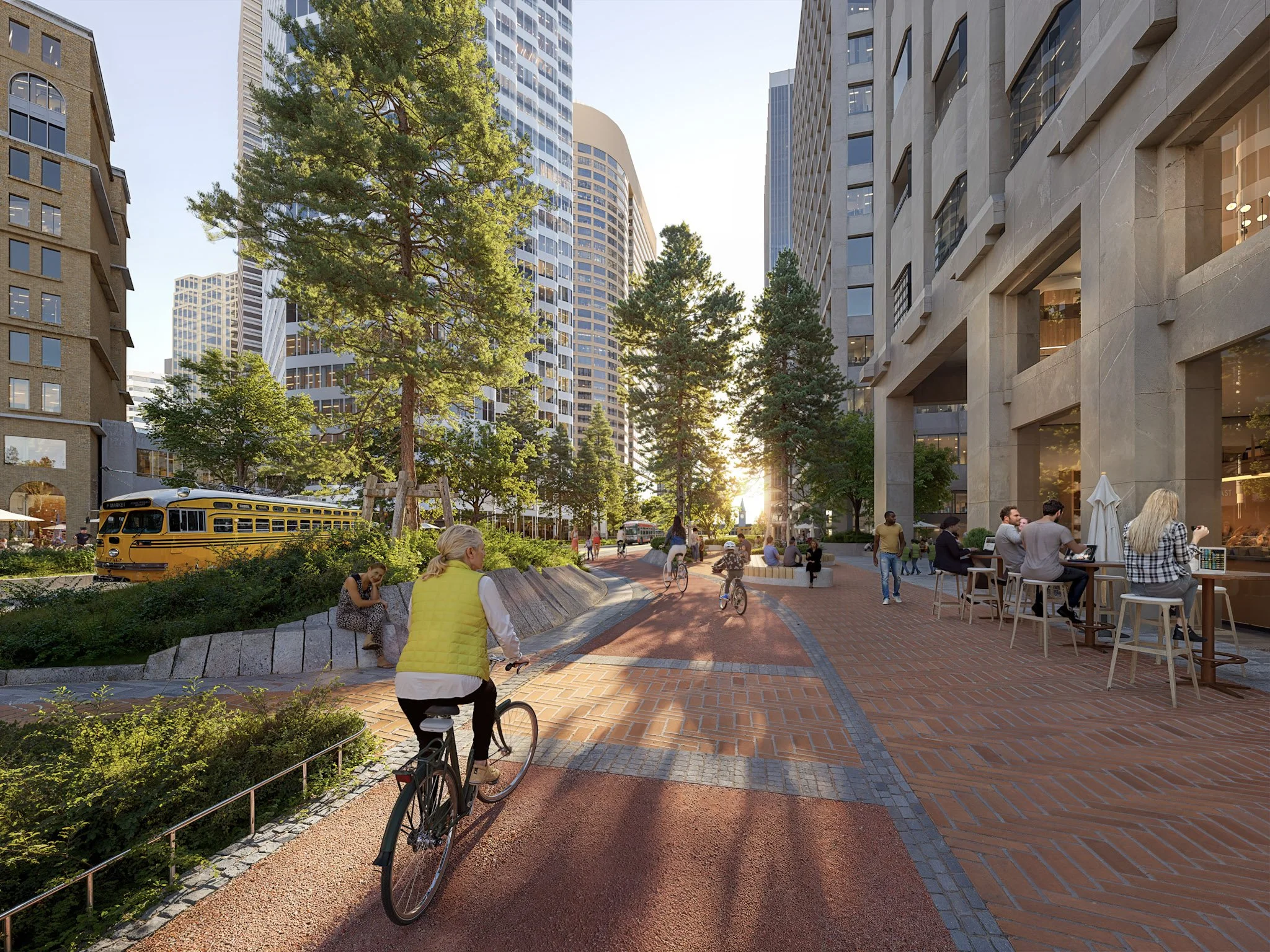
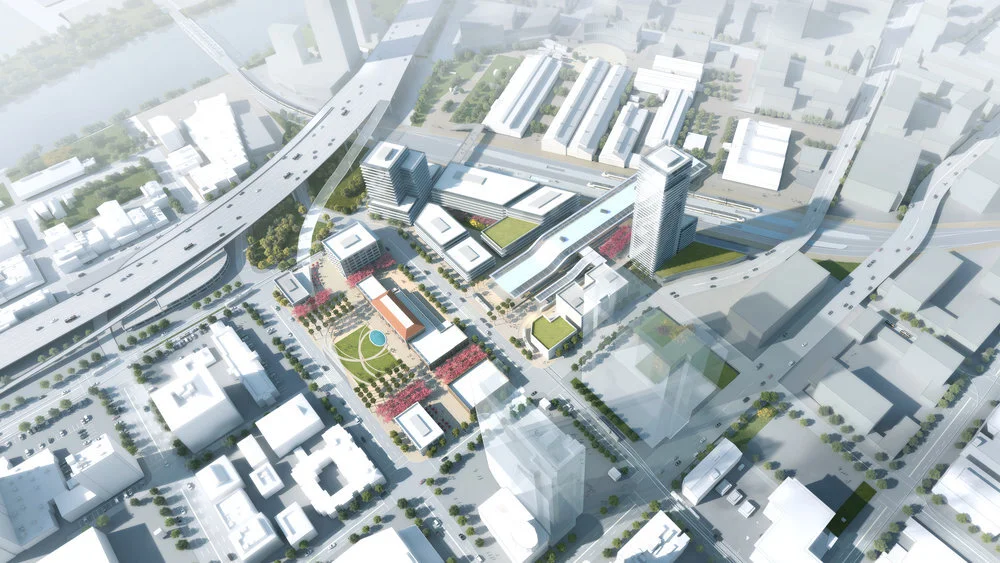
San Francisco’s Living Heart—our winning vision in ULI’s Market Street Reimagined competition—earned the Placemaking & Connectivity award, created with Studio MLA, Systematica, and Vibemap. (Image credit: Multistudio)
Once that linear foundation was set, we turned to Market Street as a system of civic nodes. Running through distinct districts, each with its own history and identity, Market Street offered opportunities to celebrate those layers with spaces that foster belonging, invite social connection, and support spontaneous play and civic gatherings. These nodes emerge where the north–south grids collide, creating irregular intersections and unexpected openings in the urban fabric. Functionally, they may be inefficient for vehicles, but socially, they hold enormous potential. That tension — the irregular, the unplanned, and the serendipitous — is what I’ve continued to explore more broadly in my own work.
M: What does that exploration look like for you?
LG: I’m referring to the exploration of what I call the Urban Theater. An odd intersection becomes a plaza. A sudden shift in the grid reveals a building façade as a backdrop. A leftover space transforms into a stage for gathering. It is in the irregular that we see the potential for the unplanned to happen and for social connections to flourish. Rather than treating these conditions as inefficiencies to be ironed away, I see them as opportunities to be elevated — moments that serve a higher goal than the efficient management of land: the fostering of human connection.
To pursue this kind of investigation, I’ve found it essential to step outside the narrow framework of specialized practice and embrace complexity through a multifaceted lens. The scale and culture of Multistudio enable a closer integration of disciplines — architecture, landscape, urban design, and mobility — each reinforcing the others. It’s an approach that is less bound by specialization and more holistic, which is the perspective I’ve always embraced.
M: How do you translate that kind of holistic exploration into your design process?
LG: Holistic exploration means accepting the unknown — starting with questions rather than preconceived answers. By looking at a problem from multiple angles, across disciplines, we allow unexpected relationships to emerge and even surprise us.
That explorative mindset, for me, is much like doodling: testing possibilities without the pressure of being right, playfully. Play is where we stop taking ourselves too seriously and give ourselves the freedom to let sensitivity lead. In other words, it’s about putting your antenna up and process conditions, opportunities, and aspirations in a sensitive way.
My work often begins with a gut feeling, something that surfaces almost unconsciously. The key is to let that intuition take shape, then crystallize it through the rigor of science.
M: What are you most looking forward to as you continue to experiment at Multistudio?
LG: For me, experimentation means embracing uncertainty. You need to get lost before you can find anything new. Cities are like that — the tighter and more efficient the structure, the more predetermined the outcomes. But when there’s room for openness and exploration, unexpected connections emerge.
Today’s complexities call for a renewed paradigm in the way we practice — one that focuses as much on human experience as it does on technical performance. As architects, we need now more than ever to exercise both the rigor of science and the uplifting power of art — and in that balance is where architecture can truly be of service.
I see that potential at Multistudio right now. The leaders who built this practice are beginning to pass the torch, and it feels like a moment of reinvention — a chance to define new frames of reference for the world we co-create. For me, that’s incredibly exciting.
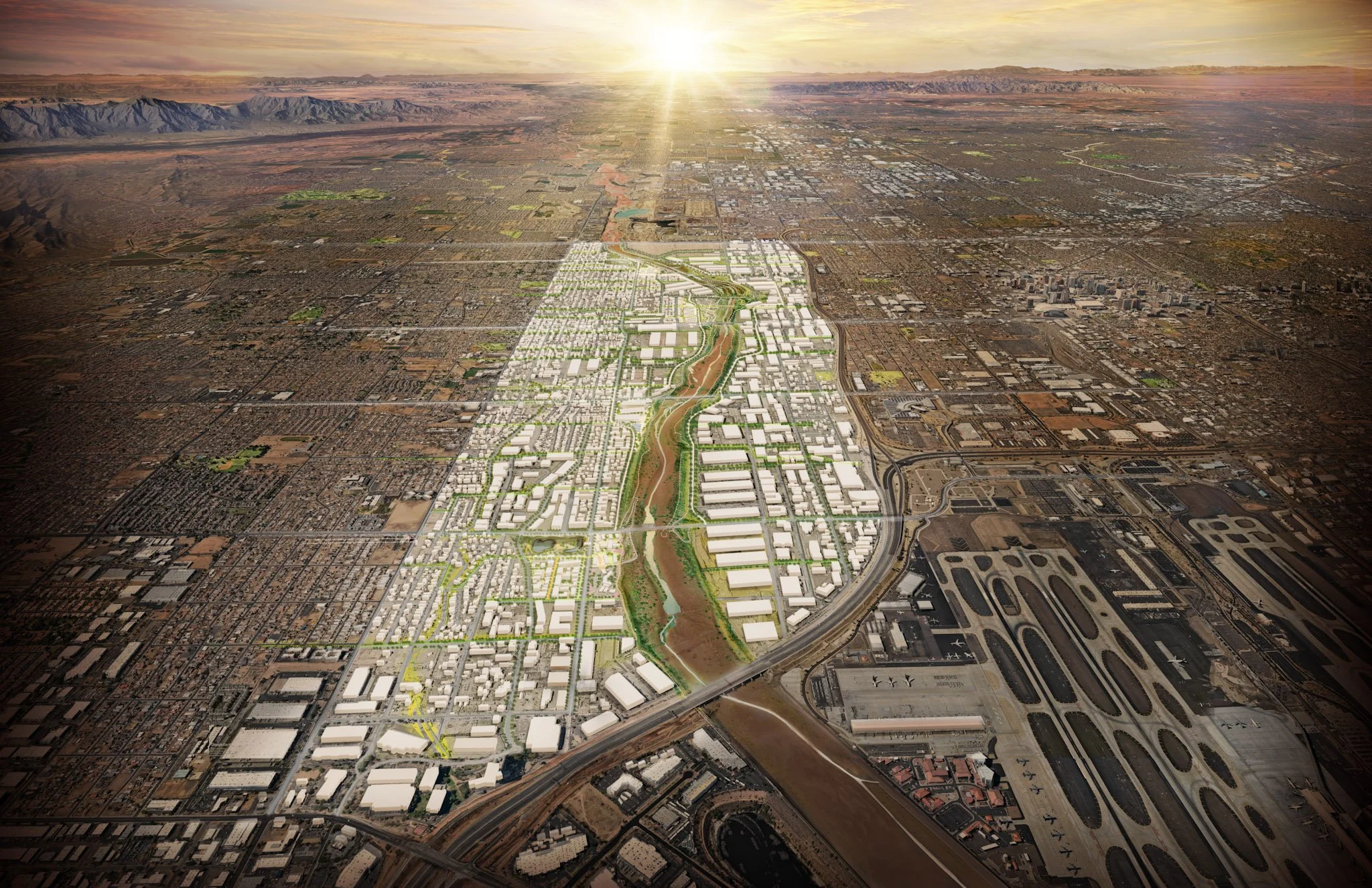
The City of Phoenix 2050 Community Vision Plan, developed by Multistudio, SCAPE, and the City, outlines a vision for 7 square miles along the Rio Salado. (Image credit: Multistudio)
This article was originally posted on Multistudio
Downtown San Francisco: The Quest for a Soul
In the last quarter of 2023, office space vacancy rate in San Francisco stood at 32%, marking a 2% point increase from the previous quarter (1). This trend suggests a lasting change in the office market and underlines how the shift in workplace habits might be here to stay. By comparison, European urban centers have demonstrated a stronger resilience in bouncing back from the pandemic (2). Despite the looming shadows of war, cities in Europe seem to have rekindled the vibrancy and dynamism typical of their urban environments. Why is that the case? Besides structural and economic differences with the US, a personal connection to places may have played a role in Europe’s urban recovery.
Figure 1. San Francisco office space rate by quarter // SOURCE: San Francisco Economic Recovery Dashboards - Figure 2. Office Vacancy Rate (%), Q4 2005 - Q4 2023 // SOURCE: JLL
Hayes Valley provides an insight into how a distinct sense of place can drive urban vitality in San Francisco. With its local boutiques, cafes, public art, and open space, Hayes Valley has emerged as one of the city’s epicenters of innovation (3), with one of the highest concentrations of AI startups in the city. According to a recent Bloomberg report the reason for Hayes Valley’s dynamism can be attributed to its ‘soul’. And this is what ultimately should be the goal for downtown, to find its soul.
Embracing the need to infuse downtown with a unique spirit, the passage of Proposition C promises to breathe new life into downtown. The provision for a one-time transfer tax waiver is designed to nudge investors into repurposing underperforming office spaces, potentially untapping approximately 4,200 housing units (4). This and other initiatives align with the city’s ‘Roadmap to San Francisco’s Future’, a nine-point strategy that aims to transform the city’s business core into a more vibrant and resilient mixed-use district, fostering a distinct sense of community and supporting innovation, creativity, and economic growth.
Left: 'Holy Stitch!' on California and Davis Street (part of 'Vacant to Vibrant' initiative). - Right: 'Park Padel' at Justin Herman Plaza.
The quality of public open spaces is key to realizing this vision. Welcoming, comfortable, and engaging public open spaces are a platform for social interaction, and are crucial to elevating the downtown experience for daily commuters, residents, and visitors alike. From work to leisure, the pandemic has starkly highlighted our desire for a deeper connection to nature and the outdoors in all aspects of our lives. Integrating more nature into downtown not only enhances its aesthetic appeal but also supports its community's mental and physical well-being while contributing to the city’s resilience objectives. The recently released Draft Plan for a more resilient San Francisco Waterfront (5) represents a significant leap forward in this direction. The $13 billion, 7.5 miles plan sets a model for how cities can adapt to climate change while enhancing urban vitality. While addressing the urgent need for effective measures against sea level rise, the plan sets the stage for a more vibrant and accessible waterfront, providing downtown with opportunities for a stronger connection to the waterfront, new public spaces, and improved access to nature.
Tentatively Selected Plan's Initial Actions of the // SOURCE: U.S. Army Corps of Engineers
As we reflect on the unique qualities of San Francisco, its natural environment should inform the vision for its downtown, a place that embodies the remarkable natural beauty of the region, enriching the life of its community. The connection to nature is deeply woven into the very lifestyle and ethos of San Franciscans, who have an intimate relationship with the ocean, the natural landscape, and the rolling fog. This profound bond with nature transcends simple enjoyment, it informs the character of the city and the spirit of its diverse community. As we stand on the brink of a new era, marked by tremendous technological leaps and changing urban dynamics, let's have the efforts to rejuvenate downtown be guided by the quest for its soul. A downtown that embodies the spirit of San Francisco's diverse community, the tireless forward-looking spirit of its people, and a deep, soulful connection with its natural environment.
(1) San Francisco office space rate by quarter (February 2024). San Francisco Economic Recovery Dashboards. Retrieved from https://www.sf.gov/data/san-francisco-office-space-vacancy
(2) Signs of gradual recovery in demand. Global Real Estate Perspective February 2024. JJL. Retrieved from https://www.us.jll.com/en/trends-and-insights/research/global/gmp/office
(3) AI map: Where the young and restless driving the AI boom hang out (October 2023). Mission Local. Retrieved from https://missionlocal.org/2023/10/ai-map/
(4) From Workspace to Homebase (October 2023). SPUR. Retrieved from https://www.spur.org/sites/default/files/2023-10/SPUR_From_Workspace_to_Homebase.pdf
(5) San Francisco Waterfront Coastal Flood Study, CA. Draft Integrated Feasibility Report and Environmental Impact Statement (January 2024). U.S. Army Corps of Engineers (USACE). Retrieved from https://www.swt.usace.army.mil/Portals/41/SFWCFS_DIFR_EIS_Main%20Report_1.pdf
Photo by Sergio Ruiz for SPUR // Edited
Future of Downtowns: Urban spaces as a platform for social connection
We are undeniably living in remarkable times. The meteoric rise of Artificial Intelligence has taken the world by storm, igniting both excitement and anxiety. On one hand AI promises to tackle some of our most urgent challenges, from health to climate change, on the other hand, it poses profound questions about what our future may look like in the next 10-20 years.
With recent studies finding that up to 49% of U.S. workers could see AI automate half or more of their tasks (1), the impact of AI on the workforce is a pressing concern.
(2) TECHNOLOGY ADAPTATION, 2023-2027: Technologies ranked by the share of organizations surveyed who are likely or highly likely to adopt this technology over the next 5 years // SOURCE: World Economic Forum, Future of Jobs Survey 2023
Having a job, “being good at something”, has always been a pillar of personal identity and a cornerstone of social engagement. Yet, recent technological advancements risk to reduce our need of human-to-human interaction, reshaping the traditional role of workplace as a social connector.
The decline in office interactions over the past few years has been stark. Work-from-home has become a permanent fixture for many, diminishing the social aspect of the work environment. As a result the vibrancy of U.S. Central Business Districts, a sign of the nation's economic vigor and a testament to urban life, has dwindled post-Covid. A study on mobile location data from the University of Toronto's School of Cities (3), reveals that, as of December 2022, while a few downtowns in medium-sized cities have seen activity levels even higher than pre-pandemic, downtowns in major urban centers continue to stagnate all across North America.
(3) RANKING OF DOWNTOWNS FOR LARGE CITIES // SOURCE: University of Toronto's School of Cities
A response to the recent downturn of urban vibrancy could be found in the personal dimension: our sense of community.
The shift away from traditional workspace dynamics to more isolated work has coincided with a surge in loneliness in the United States. The U.S. Surgeon General, Dr. Vivek H. Murthy, in a recent report titled “Our Epidemic of Loneliness and Isolation” (4) emphasizes the impact of social isolation not only on individual health but more broadly on community well-being, resilience, and economic prosperity. Dr. Vivek H. Murthy, along with a growing number of urban planners and local stakeholders, stresses the need of investing in Social Infrastructure to rekindle urban vibrancy and support a stronger sense of community.
(4) A NATIONAL STRATEGY: The Six Pillars to Advance Social Connection // SOURCE: Office of the U.S. Surgeon General
The pressing need to recalibrate the single-use nature of downtown financial districts to a more balanced mix of uses that promote social interaction and community life is reflected in the recent recommendations for Downtown San Francisco put forward by the Urban Land Institute (5). By promoting safe and reliable public transit, equitable housing, community services, and cultural venues, these recommendations aim to infuse a new life and purpose to the downtown, fostering a community that thrives on social connection.
(5) PLACEMAKING AND PROGRAMMING: The reimagined Downtown Financial District features areas dedicated to wellness, families, arts, entertainment, and culture. // SOURCE: ULI / Perkins&Will
In a post-pandemic world, we find ourselves starving for genuine human interaction. As we navigate the profound transformations of employment and the shifting dynamics of urban life, our enduring need for connection persists, underscoring the key role of urban spaces as a platform for social connection. By embracing and celebrating the local history, culture, and unique character, we can infuse new life into our downtowns, elevating them to thriving hubs of community and culture beyond the traditional workweek. Now, more than ever, it is critical that we focus our efforts on urban interventions that offer accessible, enriching, diverse, and inclusive experiences, and nurture a stronger sense of community.
(1) Eloundou, T., Manning, S., Mishkin, P., & Rock, D. (2023). GPTs are GPTs: An Early Look at the Labor Market Impact Potential of Large Language Models. Retrieved from https://ar5iv.org/pdf/2303.10130.pdf
(2) World Economic Forum (2023). Future of Jobs Report 2023 - Insight Report May 2023. Retrieved from https://www3.weforum.org/docs/WEF_Future_of_Jobs_2023.pdf
(3) Chapple, K., Florida, R., & Baum-Snow, N. (2022). Downtown Recovery: Downtown is for people. University of Toronto's School of Cities - Volume 2: Issue 3. Retrieved from https://schoolofcities.utoronto.ca/wp-content/uploads/2023/04/CityResearchInsights_v2.3.pdf
(4) Office of the U.S. Surgeon General (2023). Our Epidemic of Loneliness and Isolation: The U.S. Surgeon General’s Advisory on the Healing Effects of Social Connection and Community. Retrieved from https://www.hhs.gov/sites/default/files/surgeon-general-social-connection-advisory.pdf
(5) Urban Land Institute (2023). San Francisco Downtown Revitalization: A ULI Advisory Services Panel Report. Retrieved from https://knowledge.uli.org/-/media/files/advisory-service-panels/2023/uli-asp-san-francisco-downtown-final.pdf?rev=7b6e6771f0d74f288aad495d3878b752&hash=C4C9B058BFC616BBE2430360251BE69E
Urbanism Next 2021 Virtual Forum - Multimodal Transit and the Public Realm
The panel will discuss how a new approach to Multimodal Transit Districts can provide greater transit access while supporting Urban Development, Vitality, and Sense of Place. 2020 had a dramatic impact on cities and the way we experience the urban environment. The drastic change in mobility patterns shows how a siloed approach could threaten the existence of public transit. Technological innovation has triggered a profound transformation of the urban mobility ecosystem, that will continue at an even faster pace with the introduction of AV. By opening to new solutions, transit agencies can establish a more equitable and resilient mobility ecosystem.
Multi-modal Transit and the Public Realm
By Shin-pei Tsay, Luca Giaramidaro, and Gerry Tierney
How emerging mobility technologies can support multi-modal public transit in a post-pandemic future.
Cities have been severely impacted by COVID-19 on a number of fronts, and it has laid bare the severe disparities that result from ever-dwindling budgets. The pandemic has also dramatically changed how we experience the urban environment and required us to re-envision how people navigate and interact with their locales.
On a regional basis, commutes to central business districts have dropped dramatically, while surrounding town centers, however small they may be, have gained more activity. For the privileged, who have the ability to shelter-in-place and are supported by flexible work-from-home policies, trips have become more concentrated near their homes and rarely reach beyond neighborhood amenities. As a result, open-street networks have blossomed to allow more space for walking and biking, and cities have pivoted to allow restaurants to expand outdoor dining and retail areas into the public right-of-way (ROW). A map released by Lime, a scooter-share company, showed that, over the summer of 2020, trips have become more concentrated within neighborhoods, rather than sprawling across the city. Meanwhile, Apple Mobility Data showed that private driving returned to pre-COVID levels, after a brief reprieve in April 2020, while transit ridership is still well below normal.
It is clear that this crisis has impacted communities in very different ways. While central business district commutes might have fallen during the pandemic, cross-town trips persisted, and these are more representative of essential workers’ routes. Cities have adjusted their transit systems, cutting some routes in order to ensure more resources for higher volume routes, or contracting out late night or expanded service areas in order to ensure that all customers can be continuously served.
These changes in transportation patterns should inform how we analyze and address old problems. A longstanding challenge has been how to meet the growing transportation demand across an entire region and during traditionally off-peak times, while also ensuring that neighborhoods, town centers, and other nodes outside of the central business district can be supported with sustainable mobility options. Historically, and more than ever today, the most convenient way to travel within a region is by private car. But, as we look forward to a post-pandemic public realm, could emerging mobility technologies help?
More than ever, urban transit services are in need of sustainable and affordable solutions to better serve all members of our diverse communities, not least among them, those that are traditionally car-dependent. New mobility technologies can be a potential resource for local transit agencies to augment multi-modal connectivity across existing transit infrastructures. As we all witnessed in the last decade, technological innovation (like transportation network companies and micro-mobility) has triggered a profound transformation of the urban mobility ecosystem, enabling new shared, on-demand, and multi-modal transportation options. By being open to new technologies in the realms of both operations and vehicles, transit agencies can establish a more resilient and sustainable urban mobility ecosystem and even remove some of the friction in payment and trip-planning.
We envision a new decentralized and distributed model that provides multi-modal access through nimble and flexible multi-modal Transit Districts, rather than through traditional, centralized, and often too expensive Multi-modal Transit Hubs.
Working in collaboration with existing agencies, new micro-mobility technologies could provide greater and seamless access to existing transit infrastructure, while maximizing the potential of the public realm, creating an experience that many could enjoy beyond just catching the next bus or finding a scooter. So how would we go about it?
Step 1: Identify an area of the city with the highest concentration of transit services (e.g., local bus stops, light rail, etc.). For many communities, multi-modal transit services, when provided, come in the form of uncoordinated schedules, infrequent service, and physically disjointed and often unsafe stops located across multiple city blocks. While such areas are served by a certain level of multi-modal transit, the physical conditions in these public realms make the user experience unappealing for most, which results in low transit ridership, a deserted public realm, and increased car traffic (along with attendant pollution).
Step 2: Define the most convenient path to access each transit mode available within walking or biking distance. What are the most trafficked and convenient routes to get from one mode to another for a local transit rider? Can we determine an area within walking or biking distance that includes the most comprehensive range of local transit options available? And are there specific landmarks, destinations, and ground floor activities that could enhance these commutes?
Step 3: Provide the glue. Provide micro-mobility services and enhanced public realm solutions that enable easier, more convenient, and more desirable access to local transit. Imagine an open-air concourse: an area of the city geared to best serve pedestrians and transit commuters alike, where wider sidewalks clearly and intuitively lead you from one transit mode to another; where shared bicycle and e-scooter services are readily accessible near each local transit stop and have safe and dedicated lanes. This would be an area of the city with existing landmark destinations, active ground floors, and tailored wayfinding strategies are all coordinated to support a convenient and attractive mode transfer; where each single strategy that best serves the commuter also has positive outcomes for local residents and businesses by way of providing a more vibrant, pedestrian-oriented, and safe public realm.
The measures listed above range from low-cost, temporary solutions to permanent, long-term investments, and this range is key to a step-by-step implementation approach that should benefit communities with limited financial resources. To start, temporary parklets, paired with shared bike and e-scooter docking stations, could be located next to key local transit stops, serving commuters and providing opportunities to engage with existing ground-floor businesses. An easily identifiable network of paths comprised of easy-to-deploy low-tech way-finding solutions and dedicated micro-mobility lanes could allow commuters to intuitively find their way to the next stop.
Tactical urbanism strategies, many of which we have seen deployed in cities as a response to the current health crisis, have demonstrated how big changes can happen with small budgets when there is the will and the support of local communities. In the long term, access to efficient multi-modal services and the resulting vibrant public realm could represent a catalyst for new urban development infill to support long-term capital investments.
As the network expands beyond the central district, there are opportunities to meet demand more easily, particularly through the use of on-demand, shared transportation that is integrated with fixed route transit. Beyond the initial identification of one area that has a concentration of transit and micro-mobility, there may be several nodes throughout a region that have been reinvigorated post-COVID, and thus could benefit from the distributed transit network model as well. This coincides with shifts away from traditional “hub-and-spoke” transit models and towards an approach that allows greater lateral movement outside the city center. Imagine regions that are no longer concentrated around a single anchor of the central business district, but that have multiple anchor districts that connect to one another. And within those nodes, many points of connection could allow people to move around freely along an enhanced public realm.
Crises expose and deepen underlying societal inequity. Urban residents are now more than ever relying on the public realm to access jobs and services, conduct a healthy lifestyle, and nurture social relations. The current crisis is causing us to reconsider both the nature of transit and the role of the public realm. As a fundamental public service, public transit should be conceived as a scalable, resilient, and adaptive system, that helps communities where they are, from large cities to small towns; a system that relies on affordable and easy to deploy solutions that is at the foundation of more equitable and thriving urban communities.
This article was originally posted on Meeting of the Minds
What would it take to make a car-free Valencia Street happen?
Urban designers say Market Street-style closure is possible and could be positive for the neighborhood
Photo by Sergio Ruiz / SPUR
With most of Market Street closed downtown to private auto traffic and the initial effects on the area appearing positive, it doesn’t take long for eyes to wander to other popular but persistently gridlocked streets and wonder if it’s time to do the same there.
At least a few decision-makers at the San Francisco Municipal Transportation Agency (SFTMA) recently pondered a car-free Valencia Street, hoping to revitalize the Mission District’s critical yet sometimes struggling retail and cultural corridor.
But Valencia is an entirely different species of street than Market: narrower, more human-scale, and dominated mostly by small businesses. And unlike Market Street, Valencia isn’t a critical lifeline for Muni, which runs almost all of its north-south Mission District traffic on Mission Street itself.
To get an idea of what a hypothetical car-free Valencia Street might look like, Curbed SF asked Geeti Silwal, one of the principals at Perkins and Will, an urban design firm that worked with the city on the Market Street closure, and Luca Giaramidaro, a Perkins and Will designer who is also a Valencia Street resident.
Curbed SF: If the city were to close Valencia Street, say from 15th to 26th, how long would that take?
Luca Giaramidaro: Hard to say. Support from local businesses and local residents is fundamental, [and] that will take time and a lot of political effort. Market Street took nearly a decade. That said, examples such as Broadway Boulevard in New York City have shown that you can go a long way with a bucket of paint.
What would be the biggest obstacles?
Geeti Silwal: These projects require input and guidance from several city agencies. On Market we worked with San Francisco Public Works, San Francisco Municipal Transportation Agency, San Francisco Planning Department, San Francisco County Transportation Authority, San Francisco Public Utilities Commission, and the Office of Economic and Workforce Development.
Finding consensus is a challenge, but now that it has been done at least there is a road map—so to speak. In a tight neighborhood with small businesses like Valencia, the public involvement would likely be more intensive than we encountered with Market Street.
Also, there will be a cultural shift. Streets need to be primarily conceived as public realm. This concept has a long history in Europe, and it is time for the U.S. to shift gears on this (no pun intended).
How would a closure like this affect the neighborhood and/or retail—which is already struggling?
[Valencia Street] would become a place that people come to as a destination to socialize, linger, enjoy street life and interact with public art, nature, and each other. Streets were never meant to be just streams of vehicles but somewhere down the line, unfortunately, streets became synonymous with cars.
Market Street’s new image will be instrumental in inspiring other cities and streets globally to do the right thing [and prioritize] low-carbon modes of mobility: walking, biking, skating. It is not just the right thing to do to combat climate change, but it is also the right thing to do to address social equity. Access to employment, education, social well-being opportunities for community members of all age and income groups is possible when we make space for an efficient, dignified transit system.
One of the common obstacles of such changes is the local business opposition. Quite honestly, research has shown that local businesses thrive from improved pedestrian and bicycle access. Retail not associated with customer experience is dying in the U.S. (i.e., the Amazon effect.) Ground floor retail, food and beverage will benefit from the improvement of pedestrian and bicycle experience, especially on Valencia, which is already a destination for many weekend strollers.
Would you personally like to see Valencia Street (or any other SF street) closed to private vehicle traffic?
Yes, just like the Market Street project. Prioritizing and structuring streets for people and public life over movement of private vehicles is a fundamental goal that the entire team got behind.
[It’s] an intriguing idea, maybe 16th to 18th, where it is the busiest? Valencia Street has been already going through positive changes with improved/protected bicycle lanes and controlled TNC pickup and drop off zones (Lyft pilot project). Streets are not the same as they used to be, and we need to carefully craft a tailored strategy that responds to unique conditions. It would be very interesting to see this improvement advance towards a complete street environment. I’m thrilled to see this happening. One step closer to healthy and equitable mobility solutions for all.
There are a lot of factors that need to be considered before vacating a street. A healthy street grid provides good connectivity and democratizes a place by giving people options to navigate a city, irrespective of the mode. It is important not to impede the connectivity of a healthy city grid.
However, fewer and narrower travel lanes slow vehicles down, which in turn calms the experience of the street and makes it much more pleasant, safe and inviting for pedestrians and bicyclists. Prioritizing and structuring the street for people and public life over movement of private vehicles should be a fundamental principle for all streets. Streets need to be primarily conceived as livable public spaces.
Which means the hierarchy of mobility modes needs to put “people first.” Pedestrians and public life on streets come first, bikes next, transit third, and ultimately private vehicles.
This article was originally posted on Curbed
High Speed Rail in the US: Myth or Near-Future Possibility?
By Luca Giaramidaro
Courtesy of Flickr user Andrew Stawarz. ImageKing's Cross Station Concourse / John McAslan + Partners
In Europe, Asia, and much of the developed world, high-speed rail is convenient and accessible. Whether for business or pleasure, travelers are served by an efficient and extensive rail network that connects passengers to the desired destination on time and with relatively little effort. Although these train systems can travel as fast as 350 kilometers per hour, speed is not the only important factor. Rail stations in Europe, for example, are an integral part of the historic urban fabric. These facilities are often perceived as civic destinations that play a fundamental role in the mobility system, providing a wide range of services for the larger collective; shopping, entertainment, commercial and civic uses are often paired with transit services as new stations are built and historic stations are retrofitted.
But as California and Texas embark on the development of high-speed rail, how can urban planners and designers ensure the success of such systems in the US?
When planning for high-speed rail in the US, many of the local community members and stakeholder groups that we engage in our design process understand the efficiency, comfort, and overall benefits of high-speed rail especially as it functions in Europe.
However, the American landscape is quite different, and one recurring question we are asked is: “How do we make it work here?” While there are many lessons we can learn from Europe, the unique culture, history and physical attributes of US cities require tailored strategies. Here are three to consider:
Establish a destination
Sacramento Valleys Station Master Plan. Image Courtesy of Perkins + Will
Before even designing the station, it is important to first plan for its context. While high-speed rail stations all across Europe are, for the vast majority, at the heart of vibrant cities, in the US this is rarely the case. The high cost of infrastructure and the impact on private properties often pushes stations towards the outskirts of downtown and in some cases at the edge of the city limits. Even when the station is located within the downtown the lack of a supportive mix of uses and population densities frequently undermines the potential of rail interventions. Highly efficient, long-range rail connectivity is a critical asset and a catalyst for sustainable urban development that can positively contribute to local economic growth. High-speed rail provides an opportunity to rethink the urban environment of many American cities as well as a chance to introduce new urban spaces that are centered on people, not cars.
The design for Perkins + Will's Sacramento Valley Station aims to establish not only a functional and performing transit facility but a true gateway for the city as a whole. The new station area is designed to overcome the physical barriers surrounding the site such as the existing rail alignment to the north, the I-5 viaduct, and the 5th street overpass, and ultimately showcase the city’s culture and identity. By incorporating restaurants, art, and public gathering spaces into the design of the new station, we are able to overcome the physical barriers and bring people together.
A new system of open spaces and the extension of the existing street grids provide greater access to the site, the Old Sacramento historic district, the American River, and trails. The proposed station layout acts as a bridge straddling the existing rail alignment connecting the historic Sacramento Valley Station to the Railyards Central Shops. A well-programmed public realm and the strategic adaptive reuse of historic structures provide opportunities for community gatherings as restaurants, cafes, art galleries, farmers markets, etc. delivering a distinct sense of place that supports and celebrates the station as a new welcoming civic destination.
The master plan introduces a carefully balanced mix of uses such as jobs, housing, local and regional amenities that will leverage the proximity to transit and support a safe and engaging urban environment. This framework is instrumental in attracting new development both within and beyond the station area.
Attract an Audience
BART Station Experience Design Guidelines. Image Courtesy of Perkins + Will
Today, US rail services compete with other modes of transportation that Americans are much more accustomed to using. Cars and airplanes play an undisputed role in the American mobility system. In order to make existing and future rail services successful, it is important to not only ensure efficiency but also make rail travel appealing.
As consumers are presented with the latest model, car commercials briefly describe specifications and performance; what they are really sold on is a distinctive experience. Similarly, when planning for high-speed rail, experience must be at the center of the design process. Urban planners and designers are tasked with making sure that the journey from origin to destination is efficient, convenient, and most of all pleasant. In order to create a competitive transit service that can break into a car-dominated US market, we must work to establish an appealing user experience that does not end at the station's front door.
A cross-disciplinary approach is needed in order to deliver a project that successfully addresses each stage of the customer journey. This method leads to a design that blurs the lines between indoor and outdoor, letting elements such as mobility, public realm, active ground floor uses, identity, and wayfinding seamlessly extend into a continuous ground plane of activities serving the station and its surroundings.
Setting clear experience design guidelines is a fundamental step towards achieving this goal and transit authorities, such as BART, are incorporating this approach more frequently.
Provide a Network
Confidential US High-Speed Rail Station Area Plan. Image Courtesy of Perkins + Will
Ultimately, a rail station primarily requires strong mobility. As we step off the train in some of the most successful stations in Europe, we are immediately connected to a range of mobility options that will easily bring us to our final destination. High-speed rail relies on the ability to effortlessly transition from regional to local transit, minimizing the need for private vehicles in order to cover the first and last segment of the journey. The lack of a mature local transit network and a prevailing car-centered culture are some of the main challenges of implementing rail infrastructure in the US. When planning for it, we need to ensure that all local transit services are integrated into the station area, minimizing conflicting options and prioritizing space-efficient modes of transportation such as walking and biking.
Today, the US is at the epicenter of a mobility revolution. Transportation network technologies, such as Uber, Lyft, and other ride-sharing platforms are radically disrupting the way we move and, if well regulated, they have the potential to solve endemic challenges of many communities across America. With this in mind, high-speed rail stations should be elevated to multimodal transit hubs, capable of serving a fast-changing mobility ecosystem. Stations in the US can - and should - be new landmark destinations for commuters, visitors, and local communities alike, placed at the core of successful, vibrant mixed-use urban environments that strategically leverage access to transit.
This article was originally posted on ArchDaily
What California HSR Can Learn from Europe
By Luca Giaramidaro
Traveling by train in Europe is an experience within itself. It is not only enjoyable, it’s also an opportunity to engage with the urban environment in a very distinctive way. At a time when the new administration is promising huge investments in infrastructure, tech companies are constantly evolving the mobility scenario and California moves ahead with its contested $64 billion plan for high-speed rail (HSR), what are the lessons we can learn from the European experience?
I visited some of Europe’s best rail stations to study the aspects of their success and understand what role such infrastructure can play in American cities. Throughout my visit, three fundamental aspects emerged: context, mobility, and experience.
Context
Context is a fundamental factor for the success of any train station. Historic rail stations across Europe are often supported by well-established urban environments able to deliver a memorable experience, but in less consolidated areas HSR services can drive significant redevelopment efforts. King’s Cross is a mixed-use, urban regeneration project for an area of 67-acres that was once a gritty part of London. The site now is undergoing a radical transformation and becoming a lively and diverse new district thanks to the decision to move Britain’s first high-speed railway to St. Pancras. In addition to six underground lines and national train lines, there are HSR connections to Lille, Brussels, and Paris. This level of connectivity has allowed the development team to strategically capture the increased land value and initiate a redevelopment effort that adds residential, retail, cultural, and commercial uses to the area, attracting tenants such as Google, BNP Paribas Group, and the London University of the Arts.
Another example of urban redevelopment around high-speed stations can be found in Lyon, France. Two hours south of Paris by TGV (France’s high-speed rail), La Part-Dieu is a former military base that has now become France’s second-largest business district after La Défense in Paris. The station, Gare de Lyon Part-Dieu, is strategically paired with one of Europe’s largest inner-city shopping centers, which is located just a few steps away from the station’s main plaza. The shopping center serves as an important anchor, attracting millions of visitors per year that combined with rail travelers and commuters using local transit lines make this area a vibrant district for the city of Lyon. Due to its success, La Part-Dieu is now undergoing a second phase of transformation that will add additional office space, residential units, open space, leisure, and hospitality facilities.
While the ideal location for train stations is within a city's central area, that may not always be the case in California. For example, the California High-Speed Rail Authority is evaluating downtown regeneration potential as well as alignment options that may include multi-modal hubs outside the downtown cores. Understanding how to successfully capitalize on the newly established connectivity and add value for the local community will be critical to the success of this station.
Mobility
High-speed rail stations provide travelers with much more than just a means of transportation. The better integrated a station is into the mobility infrastructure, the more options it offers to travelers. Whether connecting to the nearby airport, linking to the local transit system, or providing first and last-mile solutions, European examples serve as multimodal hubs.
The Berlin Hauptbahnhof is one of the city’s beloved landmarks. The station’s cruciform configuration clearly follows the east-west and north-south rail alignment providing access to high-speed rail, conventional rail, and local transit. The station hall is flanked by two office towers while retail spaces are distributed on three floors. Once inside the station, passengers are immediately aware of the building’s organization. An ample glass roof and central core allow daylight to reach all the way through to lower platforms, while an intuitive design allows passengers stress-free access to multiple transit services.
But mobility doesn’t stop at the station’s front door. At Berlin Südkreuz station, the national railway company Deutsche Bahn has also provided alternative modes of transportation with specific regard to the first and last mile. In addition to a bus station and taxi stands, visitors have access to an Intelligent Mobility Station where renewable sources provide energy for a fleet of electric bicycles and electric cars.
Multimodality is a fundamental aspect of today’s mobility. With the United States spearheading the innovation in mobility with mobility-on-demand (MOD) services and autonomous vehicles, and integration of these innovative modes of transportation is key to the success of future HSR stations.
Experience
High-speed rail competes directly with other means of transportation, some of which are well-loved particularly in an auto-oriented culture like the United States. To attract users, rail infrastructure must be designed and developed with the user in mind. From booking a ticket to the arrival at the final destination, the service must be perceived as convenient and attractive.
In the tradition of grand rail station architecture, the vaulted glass and steel canopy of Liège Guillemins station is a distinctive landmark for the Belgian city. The generous roof structure covers the station’s five platforms, which have a clear functional layout, while the indoor/outdoor permeability of the building allows visitors to experience the station as an urban space. Liège Guillemins can often be found filled with travelers and locals alike, enjoying the urban terrace overlooking the large main plaza or casually gathering on the station’s front steps.
Architectural quality plays a fundamental role in delivering a memorable transit experience. Many rail stations today are in need of major upgrades to become vibrant civic destinations that are engaging and attractive to all users. Today’s transit customers, here and abroad, have higher expectations for mobility services. They are seeking an engaging, holistic experience. Successful stations must respond to their context while establishing a distinctive landmark for the city, enabling social gatherings that will enrich the experience of business travelers, tourists, and locals alike.
Lessons Learned
Successful stations around Europe are a destination in themselves, and that is one last lesson that California must take to heart. These stations have become an integral part of city centers: places for locals and visitors to gather and enjoy. Leveraging their central role in the mobility system, HSR stations elevate their status to true urban destinations by deploying well-programmed cultural and commercial offerings, as in London’s Saint Pancras Station, where the ample open concourse connecting the Eurostar, regional trains, and subway lines is full of life, featuring shops, cafés, and restaurants accessible throughout the day while music, art, and tourist attractions keep visitors entertained.
With HSR, stations in California have the opportunity not only to better connect the state but also to bring new life and strengthen local community identity.
This article was originally posted on Mass Transit Magazine
Placemaking, Mobility and User Experience
Three lenses through which approach the Sacramento Valley Station Master Plan.